What Things Business Owners Must Know About Fire Extinguishers?
Fire safety does not only involve compliance with laws by organizations, but it also involves making sure the organization is well protected from any form of fire. Fires spread very quickly and, within minutes, may lead to major financial and other losses to an organization. The fire extinguisher is one of the most important fire protection devices, but it cannot be installed alone to be effective. Business managers need to be aware of the various kinds of fire extinguishers, where to install them, how to conduct inspections, and how to train employees on how to use them in case of an emergency.
Awareness of how to maintain the fire extinguishers, their disposal, and any other compliance issues is also very crucial. Moreover, in this comprehensive blog post, we will discuss the various facts that any business manager needs to be aware of when it comes to fire extinguishers.
Things Business Owners Should Know about Fire Extinguishers
Here, we have mentioned a quick breakdown of exactly what business owners need to know to ensure the overall safety and complaint of their commercial property:
1. Fire extinguishers come in Different Types According to the Type of Fire
There are various types of fire extinguishers, as different kinds of fires require different approaches to their suppression. Thus, a fire in a kitchen will require a fire extinguisher of a completely different type than an electrical fire in an office building. When choosing fire extinguishers for your business premises, it is crucial to choose those that will allow you to solve the problem quickly without creating more danger to people around. The most popular types of fire extinguishers are:
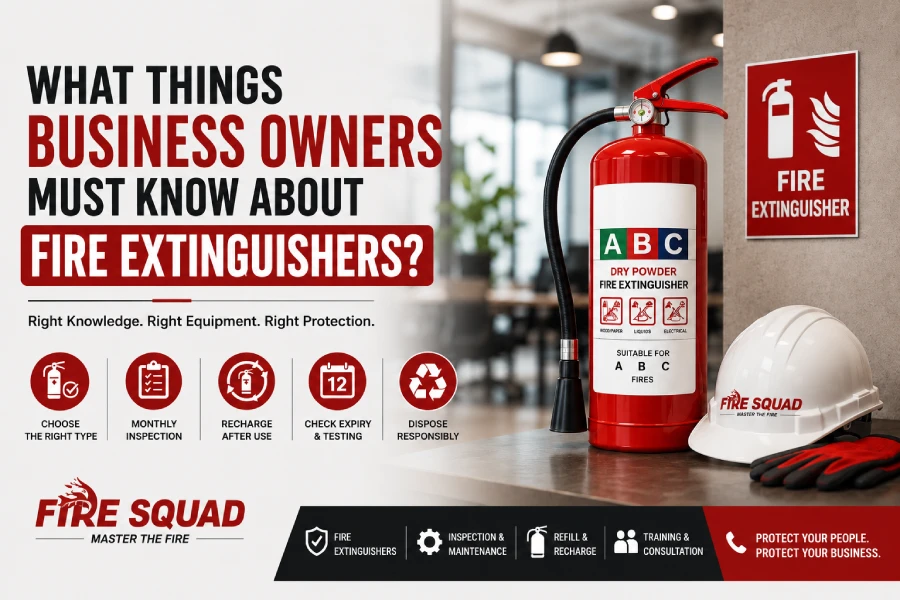
- ABC dry chemical multi-purpose fire extinguishers for Class A (ordinary materials), Class B (flammable liquids), and Class C (electrical) fires in typical workplaces.
- Water mist fire extinguishers for workplaces where sensitive equipment might be damaged by dry chemical.
- Class K wet chemical fire extinguishers for grease and cooking oil fires in commercial kitchens.
- Carbon dioxide (CO₂) fire extinguishers for Class B and Class C fires are popular in laboratories and electrical areas.
- Sodium chloride fire extinguishers for Class D fires with combustible metals in industrial areas.
2. OSHA needs a Monthly Inspection
Inspection of fire extinguishers is vital for ensuring that they are always ready to use in case of an emergency. Even though an annual inspection by a professional from a fire protection company is required, there is also a monthly inspection that is needed according to OSHA rules. It can be conducted by any of your staff members since there is no need for special skills. Here are the things that must be done during such an inspection:
- Ensuring that each fire extinguisher is in its place.
- Checking for the presence of visible damage or corrosion.
- Checking that the pressure indicator shows the right pressure.
- Making sure that the operating instructions are legible.
3. It is Important to Recharge the Extinguisher After Every Use
It does not matter whether you used a little bit or the whole extinguishing substance. The fire extinguisher has to be recharged immediately after being used. The same is true for accidental discharging. Even a partially emptied extinguisher may fail to work correctly in case of an emergency. Luckily, reusable fire extinguishers can be recharged professionally for affordable money.
4. Extinguishers come with an Expiration Date
Fire extinguishers have high durability. However, they have a certain life span. A rechargeable fire extinguisher can serve you for years if you maintain it well and conduct a hydrostatic test every 12 years. At the same time, disposable fire extinguishers cannot be refilled and must be replaced every 12 years according to NFPA regulations.
5. Dispose of Extinguishers Appropriately
You cannot throw away your old fire extinguishers with other garbage. In case the extinguisher is filled with a substance or has some pressure in it, you need to contact your local fire department and ask whether they collect old extinguishers. If not, take it to a hazardous waste disposal site. In case of a nearly empty fire extinguisher, it must be discharged of its contents by pressing the handle. It is necessary to remove the extinguisher head to prove that the cylinder is empty and then contact local steel recycling companies to check whether they accept old cylinders.
How does a fire extinguisher work?
Fire extinguishers operate by taking away one or more components of the fire triangle, which is comprised of fuel, heat, and oxygen. Each kind of fire extinguisher utilizes an element in its operation. The following are the things that need to be remembered while using a fire extinguisher:
- Pull the Pin
- Aim the nozzle at the base of the fire
- Squeeze the handle to release the agent.
- Sweep the nozzle from side to side to reach the whole area of the fire.
It is necessary to use the appropriate fire extinguisher for each kind of fire. Otherwise, the situation will become worse.
Use the Right Extinguishers in Different Fire Situations
Using the wrong fire extinguisher can be severely dangerous and can cause a fire to escalate quickly instead of preventing it. Furthermore, to securely put out a fire, you must ensure to match the fire extinguisher type to the particular fuel source of the fire. This quick reference table will showcase which fire extinguisher is perfect for each fire class, according to the international standards. Ensure to use it accordingly:
| Fire Class | Fuel Source | Correct Extinguisher | Never Use |
|---|---|---|---|
| Class A | Wood, paper, cloth, plastics | Water, Foam, ABC Dry Powder | Carbon Dioxide (CO₂) |
| Class B | Flammable liquids (gasoline, oil, paint) | Foam, CO₂, Dry Powder | Water |
| Class C / E | Live electrical equipment | CO₂, Dry Powder | Water, Foam |
| Class D | Combustible metals (magnesium, titanium) | Specialist Dry Powder | Water, CO₂ |
| Class K / F | Cooking oils and fats | Wet Chemical | Water, CO₂ |
It’s Time to Wrap Things Up!
When it comes to the right fire extinguisher, it is significant to have the correct size and number of fire extinguishers at your workplace. You must consider the overall size & layout of the building and the types of hazards present. Nevertheless, if you are searching for a reliable manufacturer of fire extinguishers, look no further than Spectra Fire. We have years of expertise and skills to help you secure your commercial or residential property from every corner. Whether you need to schedule an annual inspection, purchase new fire extinguishers, or recharge your canisters, we are your best companion.
So, if you are ready for end-to-end fire protection and prevention services, connect with our team today to know everything about fire extinguishers.
Frequently Asked Questions
As per IS 2190, the fire extinguishers shall be inspected monthly by the facility staff and shall be serviced once a year by a competent authority to make sure that the pressure, weight, and chemical content conform to the standards laid down in IS 15683.
Yes. As per NBC 2016 and local municipality fire safety rules, all fire protection apparatus fixed in commercial and industrial buildings need to be ISI marked, indicating their conformity with Indian standards.
According to the guidelines laid down in IS 2190, the travel distance to a fire extinguisher for low-hazard occupancies should normally not exceed 20 to 25 meters.
Never. Water on an electrical fire can cause electrocution. An electrical fire needs either CO2 or a Clean Agent type of fire extinguisher.
Occasionally, check your extinguisher’s pressure gauge and ensure that the needle is in the green zone. Further check that the safety pin is there with the tamper seal intact, along with the service tag being up to date. If the extinguisher has been discharged or is low on pressure, it shall be immediately recharged.