How do Fire Sprinkler Systems Work During Sudden Emergencies?
Any fire accidents may occur unexpectedly, and every second counts when trying to take care of the issue. That is why fire sprinkler systems are considered the most reliable fire safety solutions in residential, office, commercial, factory, and warehouse environments. They respond to fire, heat, and can stop and control fires immediately. As we all know, the quicker the reaction, the greater the likelihood of less damage and loss of life. That is why fire sprinklers are the most effective tools in extinguishing fires, especially in large buildings. However, the primary question is how the fire sprinkler works in fire emergencies without escalating the fire.
Furthermore, in this comprehensive blog post, we will discuss how fire sprinkler systems work during sudden emergencies. Read till the end to know more precise details.
What are Fire Sprinkler Systems?
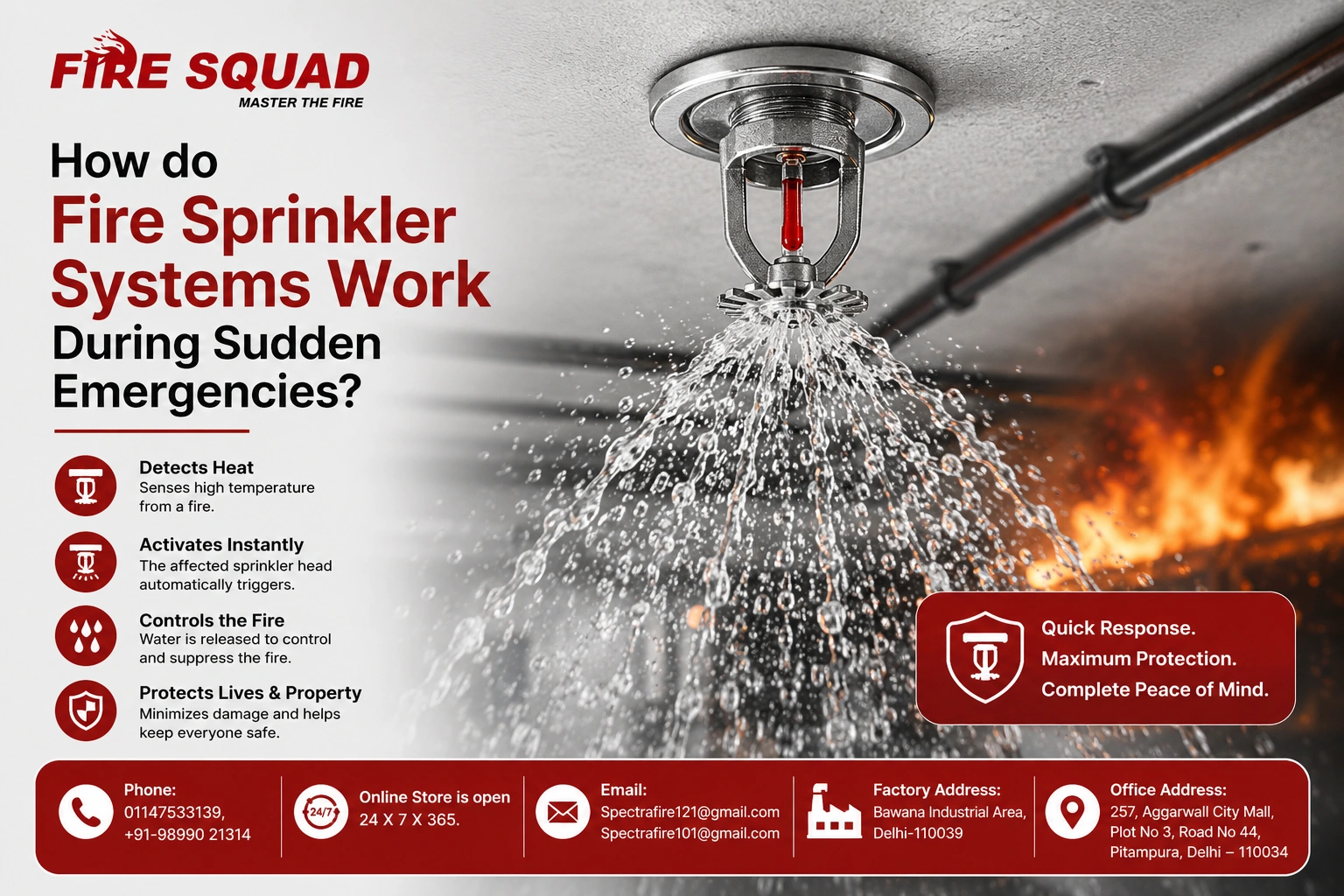
Fire sprinkler systems are made up of either water-filled or pressurized pipelines that are placed within walls or ceilings in order to prevent any spread of the fire at an early stage. Smoke is not the trigger for a fire sprinkler. Nevertheless, the heat produced by the fire bursts the glass containing fluid or bends the metallic link inside the sprinkler head. As a result, water that has been pressurized is released directly onto the fire flames, while other regions remain dry. Hence, two types of systems are a dry system in case of freezing and a wet system in the case of hot buildings.
Working functionality of Fire Sprinkler Systems
One of the main benefits of automatic fire sprinkler systems is that they function according to a simple mechanical mechanism and not purely on electricity or manually. Thus, they react quickly, minimize the property losses, and, first and foremost, save lives. Let us have a look at how these systems work.
1. Heat-Based Activation Avoids False Alarms
There is a widespread misconception about fire sprinklers being the same as smoke detectors, which is incorrect. Sprinklers do not react to any smoke, steam, or cooking fumes, but they only react to heat. Every sprinkler head contains a small glass bulb filled with some liquid. When it warms up due to the heat around the sprinkler head, it expands and bursts when the temperature goes beyond 57°C to 74°C, allowing water to come out of the sprinkler. Due to this specific mechanism, fire sprinklers are highly reliable and not prone to accidental activation caused by normal everyday actions like cooking or dust.
2. Independent Reaction Prevents Water Damage
Another widespread myth about fire sprinklers comes from various movies, where all sprinklers start working simultaneously in case of a fire. But this idea is quite misleading. Every single sprinkler operates individually. Only the sprinkler or a fire extinguisher that is nearest to the place of fire activation becomes operational, as it is the one being exposed to heat. All the other sprinklers remain closed until they sense enough heat. This targeted approach allows fighting the fire while preventing unnecessary water damage in the rest of the building.
3. Immediate Fire Suppression Due to Pressurized Wet Pipes
Wet pipe systems are the most commonly used fire sprinkler systems in the world. In this configuration, the pipes are constantly filled with pressurized water, which ensures readiness to operate at any time needed. When the glass bulb in the sprinkler head bursts, water is released immediately and goes through the pipe into the sprinkler head. Then it hits the deflector plate and is dispersed evenly in the affected area. The absence of a waiting period for water to reach the sprinkler allows for controlling the fire immediately, preventing its spread through the building.
4. Controlled Water Dispersal Saves Building Resources
Many people believe that fire sprinkler systems will create significant water damage. But in fact, these systems require much less water than regular fire hoses, which firefighters use in their work. Water is sprayed in a specially designed pattern to efficiently cool the fire and its surrounding area. As fire is controlled in its early stage, there is no necessity to use huge amounts of water to extinguish it. Therefore, fire sprinklers can spray even a very small portion of water that is required to extinguish a fire compared to hoses.
5. Smoke Reduction Makes Air Cleaner
Smoke is usually more dangerous in a fire than flames. It makes it difficult to see anything, breathe, and contain gases, which puts human lives in danger. Also, fire sprinklers or a fire extinguisher help in this situation. By suppressing the fire, sprinklers reduce the temperature, which slows down the fire-burning process significantly. This way, less smoke and toxic gases are produced, creating a safer environment for the evacuation of people while also increasing the visibility of the building for firefighters.
6. Immunity to Power Outage Ensures Continuous Functionality
Power failure is quite common during big fires, but it does not prevent the majority of fire sprinklers from working normally. Unlike traditional fire alarms that operate based on electrical mechanisms, fire sprinklers rely solely on heat and water pressure. In case of a power outage, sprinklers continue their independent activation when exposed to enough heat. Therefore, this mechanical reliability ensures the protection of people and property under any circumstances.
7. Automatic Emergency Alerts Accelerate Firefighting Process
Modern fire sprinkler systems usually operate along with fire alarm systems in order to accelerate the process of emergency reaction. When the water starts flowing through the sprinkler pipes, the water flow switch detects it and immediately turns on the fire alarm system in the building. In many cases, this signal is also sent directly to the firefighters in charge. Hence, building occupants have a chance to evacuate in a safe way while firefighters get notified in time and arrive at the place as soon as possible.
It’s Time to Wrap Things Up!
Fire sprinkler systems are a much bigger and more significant thing than a simple firefighting device. Its immediate response, quick-fire control, smoke reduction, and continuous operation in case of power failure make it one of the most efficient fire protection systems ever invented.
For those who are searching for reliable fire safety solutions, Spectra Fire is your trustworthy supplier. From high-quality fire sprinkler systems to fire protection solutions as a whole, we offer products that meet industry standards and are built to last. With our expertise, professional installation, and commitment to your safety, we help you secure your people, property, and business. Connect with our team to get more precise details about fire extinguishing products.
Frequently Asked Questions
The majority of fire sprinkler heads are activated in cases when the temperature rises to 57°C and 74°C. Heat melts the glass bulb or fusible link, and water is released to extinguish the fire.
No, each sprinkler head operates individually, and the only sprinkler activated is the one being exposed to the appropriate temperature.
Here are some vital reasons to install a fire sprinkler:
- Extinguish fires at the very beginning of their existence.
- Prevent additional property losses and minimize the downtime of your business.
- Ensure higher safety of people as sprinklers help slow down the fire spread.
Yes, since sprinkler systems use heat-responsive sprinkler heads and pressurized water, their operation does not require any electricity.
Here are some keen difference between wet and dry pipe sprinkler systems:
- Wet pipe systems have pipes full of water.
- A dry pipe system includes pressurized air in pipes and can be used in a freezing environment.
- Usage: It depends on the specifics of the building and its location.